Tuesday, May 8, 2012
The end of something special
Like a fleeting summer in Alaska, my six month internship at Toluma Farms goat dairy has quickly come to an end.
Towards then end of my internship I felt ready to move back to my fiance in Sacramento, ready to drive less, ready to go on to the next experience. But literally as soon as I arrived back in Sacramento with my car packed full of my most necessary belongings, I felt an overwhelming sense of sadness...a very special and unique life experience was decidedly over.
There are some things that I won't miss much...chickens who wake up at 5am, having only an open air kitchen with frozen pipes in the middle of winter, being so far from my family.
But there are many more things to miss...fresh eggs everyday, almost no noise pollution, beautiful scenery, working with a small crew of tightly knit people, being in the center of an exciting, growing cheese and dairy belt. And, remarkably, the goats.
True, I often felt sick of goats, hated goats, despised their very goaty natures. But now that I don't have to chase escaped goats around five days a week or fend off a pointy-horned beast with a hose, I find a warm fondness for them (but no desire to own one). I feel I didn't say a good enough goodbye to the Toluma Farm goats who were often comical, quirky and affectionate, but I have an open invite to visit and find this closure with them, ha! I now realize how much I enjoy working with and learning about animals, it is an essential contribution to my happiness.
So bring on the sheep! This Sunday it is sheep shearing time again with Flying Mule Farm. I helped out one day last year and have the opportunity to do so again, so I will take it! Flying Mule is offering a two day Wool Handling class, which includes on day in the classroom and one day helping with the shearing. If you are interested you can let me know and I will send you the details.
Wednesday, April 25, 2012
Getting schooled in cheese
Last week I was fortunate enough to squeeze into the packed Principles and Practices of Cheese Making course at the College of Mairn. Having dabbled in home cheese making with my friend Courtney, I knew the basics of the cheese making process but there was plenty of new information I attempted to absorb.
Perhaps one of the most surprising things I learned was that we could successfully make cheese in a plastic rectangular tub from K-Mart, with plastic utensils, in a room where we had little control over the air, water or milk temperature. In this country, cheese you purchase at a store or market is made in a government inspected, sterile facility with stainless steel equipment and highly regulated temperature and humidity control. Truly, our conditions were not preferable but it was interesting to learn we could produce a tasty cheese like this.
It certainly helped to have an extremely knowledgeably instructor, Marc Bates, who was the creamery manager at Washington State University for 27 years. Using milk purchased from nearby Strauss Dairy, half the class made feta cheese in small groups and the other half the class made Havarti.
![]() |
| My group made Havarti - cutting the curds |
| The next day, after the molded cheese sat in a cold water bath overnight |
| A "make sheet" was new to me and extremely helpful for keeping track of what we did-to duplicate or adjust depending on results |
It was a good class with a great instructor, highly recommended if you are interested in making cheese in your own kitchen or looking into it as a possible career.
Saturday, March 31, 2012
To Milk a Water Buffalo
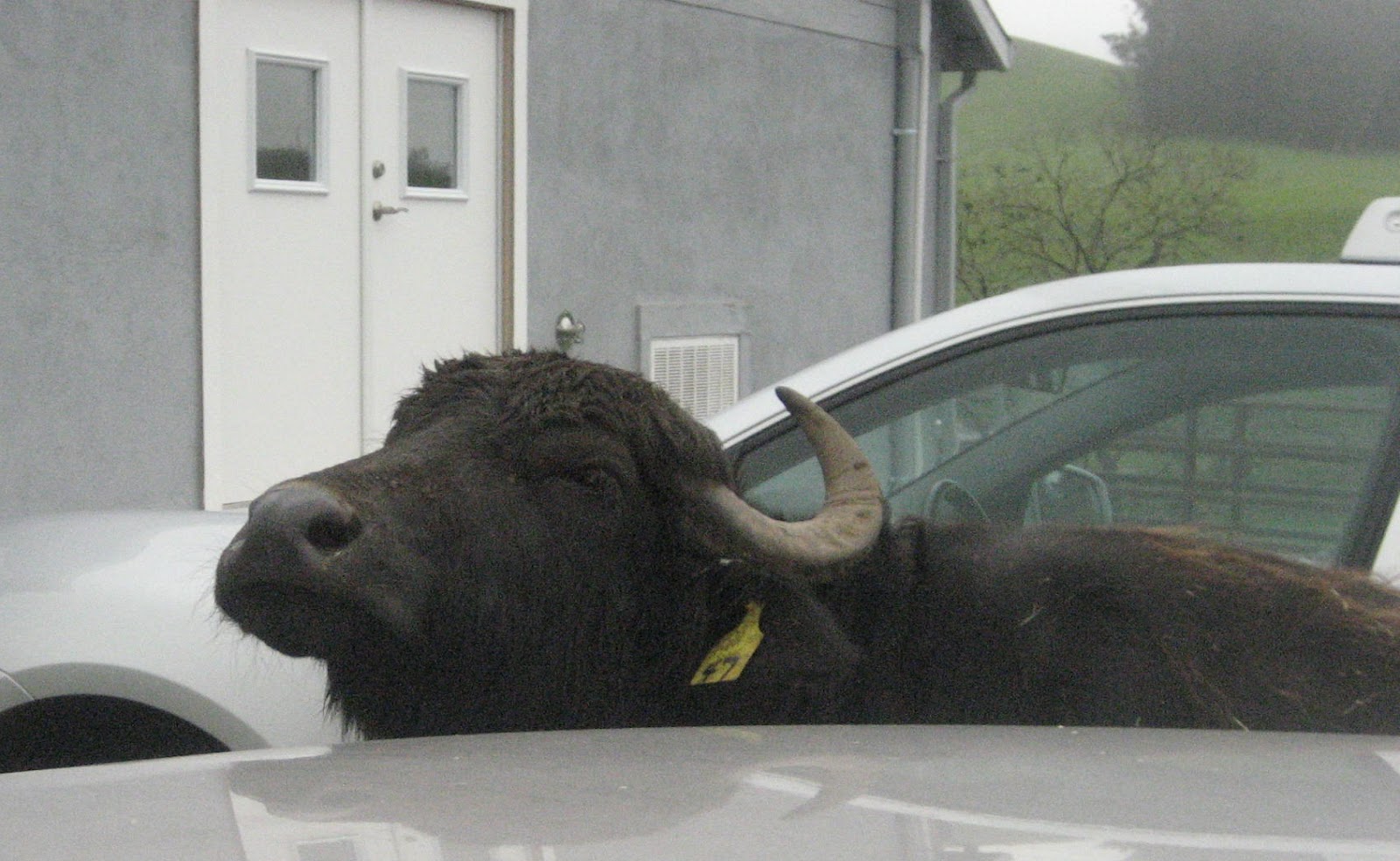
How about milking one of these...
| Female water buffalo |
...with one of these...
| Portable bucket milker |
...in one of these...
| Custom, work in prograss, water buffalo milking stanchion |
This is exactly what Craig Ramini of Ramini Mozzarella is doing. I had the opportunity to get an up close and personal look of the animals and facilities this week.
Buffalo milk is used to make yogurt and mozzarella cheese, or Mozzarella di Bufala, which has a long history in Italy. Water buffalo milk is prized for it's creamy texture and high fat content, plus it is a speciality product that commands a premium price.The fat or butterfat content of milk determines how much solid cheese you can get from the milk. The higher the butterfat content, the more cheese you get from each gallon of milk. You can see from the table below, cows and goats have fairly low butterfat contents, sheep are significantly higher and water buffalo are higher still.
| Constituents | unit | Cow | Goat | Sheep | Water Buffalo |
|---|---|---|---|---|---|
| Water | g | 87.8 | 88.9 | 83.0 | 81.1 |
| Protein | g | 3.2 | 3.1 | 5.4 | 4.5 |
| Fat | g | 3.9 | 3.5 | 6.0 | 8.0 |
| Carbohydrate | g | 4.8 | 4.4 | 5.1 | 4.9 |
| Energy | kcal | 66 | 60 | 95 | 110 |
| kJ | 275 | 253 | 396 | 463 | |
| Sugars (Lactose) | g | 4.8 | 4.4 | 5.1 | 4.9 |
| Fatty Acids: | |||||
| Saturated | g | 2.4 | 2.3 | 3.8 | 4.2 |
| Mono-unsaturated | g | 1.1 | 0.8 | 1.5 | 1.7 |
| Polyunsaturated | g | 0.1 | 0.1 | 0.3 | 0.2 |
| Cholesterol | mg | 14 | 10 | 11 | 8 |
| Calcium | IU | 120 | 100 | 170 | 195 |
Mr. Ramini said his water buffalo currently produce about two gallons of milk per day (16 pounds). This was shocking when compared to a dairy cow that produces about 8 gallons of milk a day (64 pounds). But dairy cows have had decades of heavy genetic selection so only the most productive milkers ever reproduce; water buffalo have not had that kind of genetic pressure. And when the premium price of buffalo milk and cheese is considered as compared to the price paid for cow milk and cheese, it more than makes up for this lack of volume in the water buffalo.
Mr. Ramini also very recently finished his micro-creamery where he is in the experimental stages of his mozzarella production. He rents out this small but highly functional space out to several other cheese makers.
| Love the windows, lots of light and great for tours to see the action |
| Cheese vat, temperature recorders and curd knives |
I throughly appreciated the opportunity to tour the Ramini facilites and see these fairly wild beasts interact with people. Probably a once in my lifetime experience!
| 11 day old calf of mother in the top photo. You don't get milk without a birth! |
Tuesday, March 27, 2012
Farm Firsts in the Rain
Though Toluma Farms, where I currently intern (for another 5 weeks!), is mostly a goat dairy, we do have twelve East Fresian ewes and a ram (ie dairy sheep). Before I arrived last fall, the ram was bred to the ewes so they would lamb this spring (a sheep's gestation period is approxitmatly 147 days, 5 months). We had been expecting the lambs sometime after April 1st but this last Saturday during a downpour I was pleasantly suprised to discover a hearty ram lamb and his mother in the pasture.
We brought them into a freshen pen the barn (not without a struggle, our sheep are a tad wild as they have never been milked) and gave them dry straw to rest on, as well as plenty of food and water for the ewe. Since Saturday four more ewes have lambed and all are doing well.
East Fresians are pretty much the only dairy sheep breed we have in the United States. They are the most common and genreally the most productive dairy sheep in the world. There are many other kinds of dairy sheep out there, including the Awassi and Assaf from Israel, the Lacune from France (from which we get the very famous Roquefort cheese), the Sarda from Spain and the Chios from Greece. Currently we are unable to import any live sheep, embryos or seman into the US from other countries, as the USDA has closed it's borders in fear of importing diseases, among other issues.
The owners of Toluma Farms are interested in producing a mixed milk cheese in the future, so that is the reason we have a flock of sheep. They are trying to convince the farm manager it would be a great idea to milk a couple cows as well!
We brought them into a freshen pen the barn (not without a struggle, our sheep are a tad wild as they have never been milked) and gave them dry straw to rest on, as well as plenty of food and water for the ewe. Since Saturday four more ewes have lambed and all are doing well.
East Fresians are pretty much the only dairy sheep breed we have in the United States. They are the most common and genreally the most productive dairy sheep in the world. There are many other kinds of dairy sheep out there, including the Awassi and Assaf from Israel, the Lacune from France (from which we get the very famous Roquefort cheese), the Sarda from Spain and the Chios from Greece. Currently we are unable to import any live sheep, embryos or seman into the US from other countries, as the USDA has closed it's borders in fear of importing diseases, among other issues.
The owners of Toluma Farms are interested in producing a mixed milk cheese in the future, so that is the reason we have a flock of sheep. They are trying to convince the farm manager it would be a great idea to milk a couple cows as well!
Labels:
dairy lamb,
dairy sheep,
East Fresian,
sheep milk,
Toluma Farm
Thursday, March 15, 2012
Kidding Log - 5 and then some
With so much going on in real life, it has been difficult to sit myself down and work up a blog in cyberspace. But is it time for an update...
Here at Toluma Farms we can see the light at the end of the kidding season tunnel. As of this moment 106 does have kidded 245 kids (averaging 2.3 kids per doe), with buck and doe kids nearly even. Here's a short video of the little does we are keeping playing queen of the straw stack (requires a turn of the head or the computer).
one minute of pure yay. from nena johnson on Vimeo.
Almost all of our does will have kidded by the end of March. As each doe kids, we add her to the milking line; thus milking twice daily is fast becoming much more time consuming.
Some rain as finally arrived in our neck of the woods, creating a sense of relief and gratitude in the farming community and I finally get to put my rain jacket to some serious use. I have less than two months left at my internship here and have been thinking about my next steps in farming and life quite a lot.
I recently picked up another job, bookkeeping for Soil Born Farms, an urban agriculture education farm in the Sacramento area. Obtaining this position at this time was great as it combines my passion for farming with my skills in accounting and the timing for Soil Born couldn't have worked out better.
And then there is wedding planning...tents and flowers and dresses, oh my! There is such a riduclous amout of details that go into planning an event like this, I'm glad it's a once in a lifetime event! Thankfully I have some very helpful friends and family.
With all this going on at once, I wonder how I will feel in June, when the internship is over, the wedding is over, the excitement has died down...will I feel a great let down? Will I find 15 other pursuits to add to my plate? Or will I be ready for and appreciate a little break?
Here at Toluma Farms we can see the light at the end of the kidding season tunnel. As of this moment 106 does have kidded 245 kids (averaging 2.3 kids per doe), with buck and doe kids nearly even. Here's a short video of the little does we are keeping playing queen of the straw stack (requires a turn of the head or the computer).
one minute of pure yay. from nena johnson on Vimeo.
Almost all of our does will have kidded by the end of March. As each doe kids, we add her to the milking line; thus milking twice daily is fast becoming much more time consuming.
Some rain as finally arrived in our neck of the woods, creating a sense of relief and gratitude in the farming community and I finally get to put my rain jacket to some serious use. I have less than two months left at my internship here and have been thinking about my next steps in farming and life quite a lot.
I recently picked up another job, bookkeeping for Soil Born Farms, an urban agriculture education farm in the Sacramento area. Obtaining this position at this time was great as it combines my passion for farming with my skills in accounting and the timing for Soil Born couldn't have worked out better.
And then there is wedding planning...tents and flowers and dresses, oh my! There is such a riduclous amout of details that go into planning an event like this, I'm glad it's a once in a lifetime event! Thankfully I have some very helpful friends and family.
With all this going on at once, I wonder how I will feel in June, when the internship is over, the wedding is over, the excitement has died down...will I feel a great let down? Will I find 15 other pursuits to add to my plate? Or will I be ready for and appreciate a little break?
Labels:
baby goats,
goats playing,
Soil Born,
Soil Born Farms,
Toluma Farms
Sunday, February 19, 2012
Layers of a farm
Toluma Farms has many layers to it besides just goats. They include enterprises like pasture management, growing oat hay, giving lots of public tours and raising beef cattle. One of the Farms most profitable layers quite literally lay a variety of beautiful eggs. Here is a look at the fowl of Toluma Farms and the valuable little nuggets they produce.
| Buff Orpington rooster - no eggs from him |
| Welsummer hen - lay the beautiful brown speckled eggs (my favorite!) |
![]() |
| Black Sex Link hen - lay brown eggs |
| Golden Laced Wyandotte hen - lay brown eggs |
| Rhode Island Red hen - lay brown eggs |
| Barred Rock hen - lay brown eggs |
| Light Brahma rooster & hens - lay brown eggs |
| Ameraucana hen - lay the green eggs |
| Ancona hen - lay the white eggs |
And while our resident peacock is not much of an egg layer, he sure is a stunner...too bad the goats don't really appreciate his display!
Labels:
chicken types,
chickens,
colored eggs,
peacock,
Toluma Farm
Tuesday, January 31, 2012
-Insert cheesy title here-
![]() |
| Experimental sheep milk cheese |
The college offers an entire program, created in conjunction with the UC Cooperative Extension office and the California Artisan Cheese Guild, that can be taken in order to earn an artisan cheesemakers certificate. The other classes in the course include:
-Hygiene and Safety in Cheesemaking
-Basic Starter Cultures for Cheese and Fermented Milks
-Milk Types and Quality
-Cheese Chemistry
-Principles and Practices of Cheesemaking
I will get the chance to also take the hygiene class during my internship at Toluma Farms and hope to eventually complete the whole program.
Subscribe to:
Posts (Atom)