Showing posts with label cheese making. Show all posts

Wednesday, April 25, 2012

Getting schooled in cheese

Last week I was fortunate enough to squeeze into the packed Principles and Practices of Cheese Making course at the College of Mairn. Having dabbled in home cheese making with my friend Courtney, I knew the basics of the cheese making process but there was plenty of new information I attempted to absorb.

Perhaps one of the most surprising things I learned was that we could successfully make cheese in a plastic rectangular tub from K-Mart, with plastic utensils, in a room where we had little control over the air, water or milk temperature. In this country, cheese you purchase at a store or market is made in a government inspected, sterile facility with stainless steel equipment and highly regulated temperature and humidity control. Truly, our conditions were not preferable but it was interesting to learn we could produce a tasty cheese like this.

It certainly helped to have an extremely knowledgeably instructor, Marc Bates, who was the creamery manager at Washington State University for 27 years. Using milk purchased from nearby Strauss Dairy, half the class made feta cheese in small groups and the other half the class made Havarti.

My group made Havarti - cutting the curds
The next day, after the molded cheese sat in a cold water bath overnight
A "make sheet" was new to me and extremely helpful for keeping track of what we did-to duplicate or adjust depending on results

It was a good class with a great instructor, highly recommended if you are interested in making cheese in your own kitchen or looking into it as a possible career.

Tuesday, January 31, 2012

-Insert cheesy title here-

Experimental sheep milk cheese

Last night I started the first of a four week class, A Full Introduction to Artisan Cheese and Its Histories at the College of Marin. It covers topics like classifications of cheese (hard, soft, washed rind, bloomy rind, blue), how to professionally assess a cheese (sight, smell, touch, taste, after taste), cheese history and more. This class attracts a variety of folks, from chefs, to farmers, to cheesemakers and lots of cheese eaters. It is a bit torturous to sit through, as everyone has a tray with eight different cheeses sitting in front of them that are not supposed to be eaten until two hours into the class!

The college offers an entire program, created in conjunction with the UC Cooperative Extension office and the California Artisan Cheese Guild, that can be taken in order to earn an artisan cheesemakers certificate. The other classes in the course include:
  
    -Hygiene and Safety in Cheesemaking
    -Basic Starter Cultures for Cheese and Fermented Milks
    -Milk Types and Quality
    -Cheese Chemistry
    -Principles and Practices of Cheesemaking

I will get the chance to also take the hygiene class during my internship at Toluma Farms and hope to eventually complete the whole program.

Tuesday, November 8, 2011

Dairy Sheep Mania


This past weekend I had the opportunity to attend the 17th Annual Dairy Sheep Symposium. For the first time ever the Symposium was held on the West Coast, in Petaluma, California (lucky us!) There were easily over a hundred people at the conference and plenty who couldn't make the trip…it is surprising to see how many people are interested in this sheep milking/cheese making niche!

There were two days of conference-like activity, with various speakers and discussions ranging from mobile milking parlors, to artificial insemination of dairy sheep, to cheese making and marketing information, to results of scientific research projects related to dairy sheep. Included was a cheese tasting, where many attendees brought their wares to sample, as well as a banquet featuring local lamb.

An ewe being inseminated in the "cradle of love"

The symposium also included a day of touring three local sheep dairies; Marin and Sonoma counties have a “Cheese Trail” and the largest (growing) concentration of artisan cheese makers in California. We first visited Bellwether Farm and Artisan Creamery, which produces several sheep milk cheeses, sheep milk yogurt and cow’s milk cheese.

Bellwether's ewe lambs

Bellwether's cheese aging room

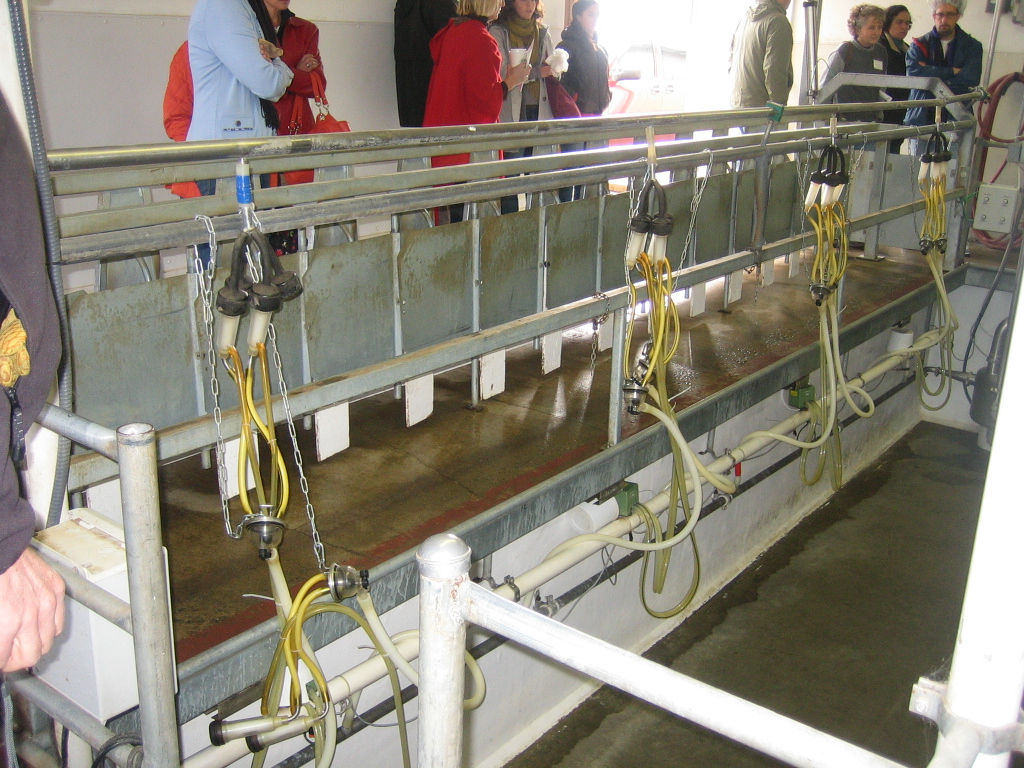
Bellwether's milking parlor - this is where milk comes from!

We then stopped by Haverton Hill, where they have high tech electronic ear tags for all the sheep that sync to electronic milking equipment; all the milking stats for each sheep is sent directly to a computer for ease of tracking and decision making. 


The last farm we visited was Weirauch Creamery, one of the newest in the area. The owners have converted an old portable classroom into their creamery and are in the process of converting another into their milking parlor.


Their small pasteurizer and cheese vat

To be honest, the more I heard and saw at this symposium, the more overwhelmed I felt. Sheep dairying and cheese making is far from an easy or cheap profession to get into. It seems to me that there are three way’s a person gets into it – by inheriting a working dairy, by having a large amount of off farm income to dump into starting a dairy, or - for those with neither of those options - by going into substantial debt to follow an internal passion.

Everywhere I look, small farmers face massive challenges to start and sustain their farms. I wonder why is farming on a small scale is so unrealistic? Perhaps we are not placing enough value on what we eat. Agriculture should be what sustains our communities and creates health for us and our environment.  Small, local farms are an incredibly important piece of our "green" future and deserve our support.